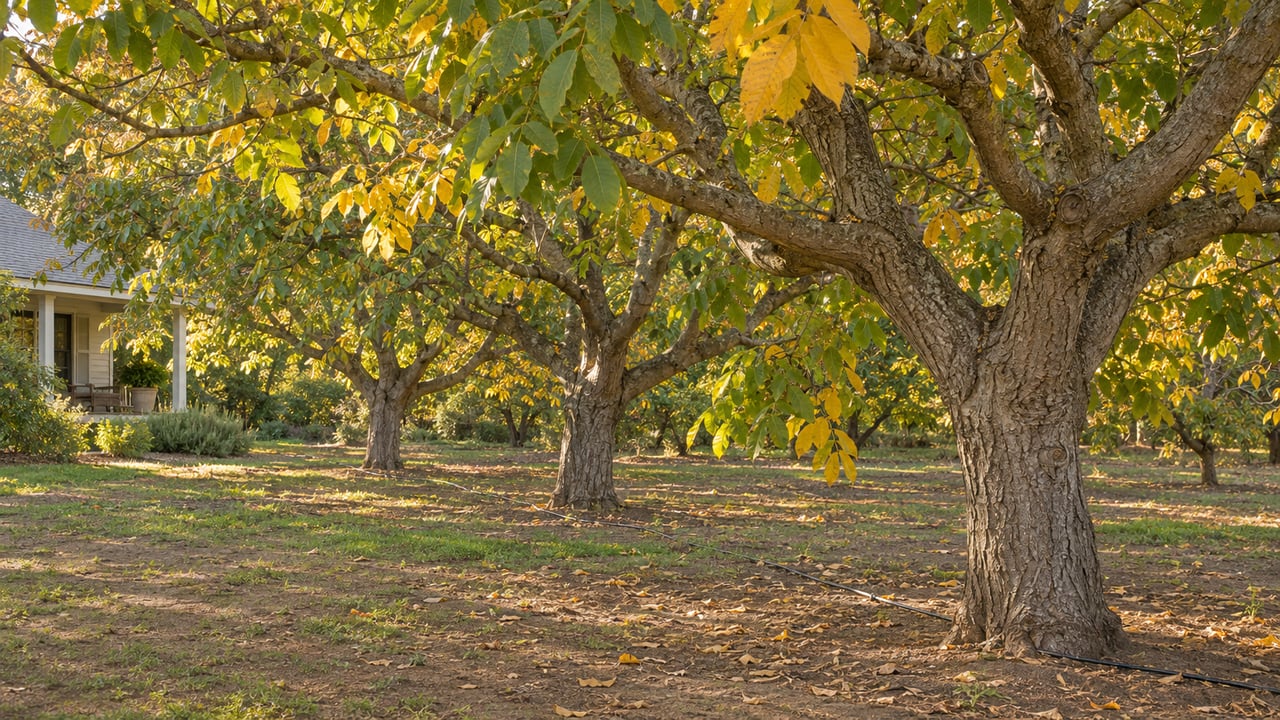
In 2025, Butte County's almonds and walnuts each grossed about 18% more than the year before, and they got there in opposite ways. Almonds gained on price. Walnuts gained on tonnage while their price fell. That gap matters if you're looking at a home on Durham-Dayton Highway, Midway or Durham-Pentz Road with a few acres of producing trees out back. An orchard's year comes down to two numbers, price per ton and tons per acre. The county headline blends both. The block you'd be buying has its own history on each.
Butte County posted its 2025 Crop & Livestock Report on September 22, 2026. It's the newest full-year picture of the orchards around Durham. Total gross agricultural production for calendar year 2025 was $702,732,779, which is $113,667,151 more than 2024. The county's own announcement says these figures are gross values. They leave out production and marketing costs and don't reflect grower income. That caveat is a good place to start when you evaluate any orchard parcel.
Two crops, one gain, opposite causes
Start with almonds. Butte County's average almond price rose from $3,900 a ton in 2024 to $4,690 a ton in 2025. Tonnage slipped slightly over the same two years, from 31,428 to 30,850. Gross almond value went from about $122.6 million to $144.7 million. Nearly all of that gain came from price.
Walnuts moved the other way. The county's average walnut price fell from $1,720 a ton in 2024 to $1,650 in 2025. Production jumped from 87,363 tons to 107,862 tons, and yield rose from 1.7 to 2.1 tons per bearing acre. Gross walnut value climbed from about $150.3 million to $178.0 million. All of the walnut gain came from the trees producing more, and it happened in a year when each ton sold for less.
For a buyer, this means a seller's strong 2025 can come from two different places. A good almond year on a Durham block may mostly reflect the market, which the next owner can't count on repeating. A good walnut year may reflect a heavy crop, which also varies from season to season. Either way, one season's check says little about what the orchard earns in a normal year. You need several years of its own records.
What an acre grossed, and what an acre costs
Dividing the county's 2025 gross value by bearing acres gives a rough per-acre figure. That works out to roughly $4,220 for almonds across 34,278 bearing acres and roughly $3,465 for walnuts across 51,363 bearing acres. These are countywide averages for 2025, before any costs. A single Durham block can land well above or below them.
Cost figures are older. UC Davis's 2024 Sacramento Valley almond cost study uses January 2024 prices. It models about $7,800 per acre in total annual costs. That breaks down into $3,720 in operating costs, $662 in cash overhead and $3,418 in non-cash overhead, a category that covers capital and land. For walnuts, a UC Cooperative Extension article in the Winter 2026 Sacramento Valley Walnut News puts total production costs at $8,081 per acre. That figure uses 2022 cost data restated in 2025 dollars.
These numbers come from different years and different methods, so treat the comparison as rough. Even so, the pattern is plain. In the almond model, 2025's county-average gross per acre sits near the cash cost of farming an acre, and well below the full cost once land and capital are counted. So when you look at a Durham home with an orchard, the trees mostly help cover the cost of holding the land. Paying for the land outright is a lot to ask of them. That's a different way to price a listing than treating the orchard as a second income.
Why a five-acre block is a different business
The UC almond study models a 105-acre owner-operated farm. It also cautions that smaller, noncontiguous parcels can cost more per acre, because crews and equipment have to travel between sites and be recalibrated. The same study assumes a custom operator handles mechanical harvest: shaking the nuts into windrows and hauling them to the roadside truck or the huller.
An owner of an eight-acre walnut block who hires out harvest is buying the same service on a much smaller job. So the cost question for a small block is who already does the work and what they charge. A per-acre average from a 105-acre model won't answer it.
Leasing is the other common arrangement. The 2023 ASFMRA Trends report groups Butte with Colusa, Glenn and Tehama counties. It lists almond leases at a 25% to 30% share and walnut leases at 25% to 35%. That table is from 2023 and gives shares, not dollars per acre. Whichever arrangement a block runs under, the terms in place are something to see on paper before you write an offer.
Who farms the blocks around Durham
Several farm-service firms list orchard work for Butte County growers, and one names Durham directly.
Capay Farms says it expanded its custom farming and harvest services in Butte, Glenn and Tehama counties in 2020. It now manages roughly 14,000 acres of walnuts and almonds, with work running from land development and pollination through nutrition and harvest. Its walnut hulling and drying operation says it serves growers in those three counties, small growers included. It handles custom lots and same-day hulling on two lines rated at 450 tons per eight hours.
T2 Farms lists orchard work around Durham, including mowing, discing, spraying and ground preparation. Chico Nut Company is at 2020 Esplanade in Chico. It says it grows, harvests, processes and sells almonds and walnuts for itself and for other growers, for domestic and export markets.
When you look at a listing with trees, find out which firm has been mowing, spraying, shaking and hulling for that block. A long working relationship with a known operator usually comes with records you can ask to see. If the work has been done by whoever was available each fall, there may be little paper behind the seller's numbers.
November on the orchard calendar
This post goes out in the third week of November, and Durham's orchards are between seasons. On October 28, 2026, Butte County Agricultural Commissioner Katharine Quist announced that the annual walnut buying period would open November 1. The opening follows the end of the Chandler walnut harvest, and the date is set in consultation with a committee of walnut growers. The same announcement calls walnuts Butte County's highest-valued agricultural commodity.
Harvest timing shifts from year to year as well. The Chico Enterprise-Record reported in August 2026 that Butte County's fruit and nut crops were looking at a slightly early harvest. In late January, the Enterprise-Record pictured an orchard outside Durham as warm weather pushed almond bloom closer. Late fall through bloom is the quiet stretch when an orchard parcel is easiest to walk and when last season's settlement statements are newest. If the timing fits your plans, it's a sensible time to look at Durham acreage.
The region's farming history is on display just up the road. Patrick Ranch Museum sits on 28 acres between Chico and Durham, centered on the 1877 Glenwood Farmhouse. It interprets the area's agricultural heritage and has been open to the public since 2010.
The questions that price the orchard
The county report gives you the backdrop. The value of a specific Durham block comes from its own records, and these questions get to them:
- Who farms the block now, and under what arrangement: a share lease, custom farming, or the owner doing the work?
- What do the settlement statements from the handler or huller show for the last several seasons, in both tons and price per ton?
- How many trees are bearing, and how many are young? The 2025 report counts 3,829 nonbearing acres of almonds out of 38,107 total, and 3,862 nonbearing acres of walnuts out of 55,225. Countywide, growers are still putting in new trees, and a young block won't produce for a while.
- Will the current operator keep farming after the sale, and on what terms?
- Which huller or processor has taken the crop, and is that relationship expected to continue?
Total acreage barely moved in 2025. Almonds went from 38,314 acres to 38,107, and walnuts from 55,631 to 55,225. Countywide, orchards are holding steady. Because the county-level picture changes so little, what separates one Durham listing from the next is its own block's record.
If you're weighing a Durham parcel, our Durham neighborhood page covers the community. Our post on Durham's well and septic rules covers the other infrastructure that comes with rural acreage. Owners getting ready to list can start with preparing a small-acreage home for sale in Durham. The cost and price figures above are general information, not legal, tax or financial advice. Please confirm your own situation with your accountant, lender or farm advisor before you act on any of them.
If you own a Durham home with trees out back and want to know how buyers are likely to weigh that orchard this winter, Lora Trenner is glad to talk it through with you. Start with a home valuation, and bring your orchard's last few seasons of records to the conversation.